Oxytocin–dopamine interactions in prairie voles
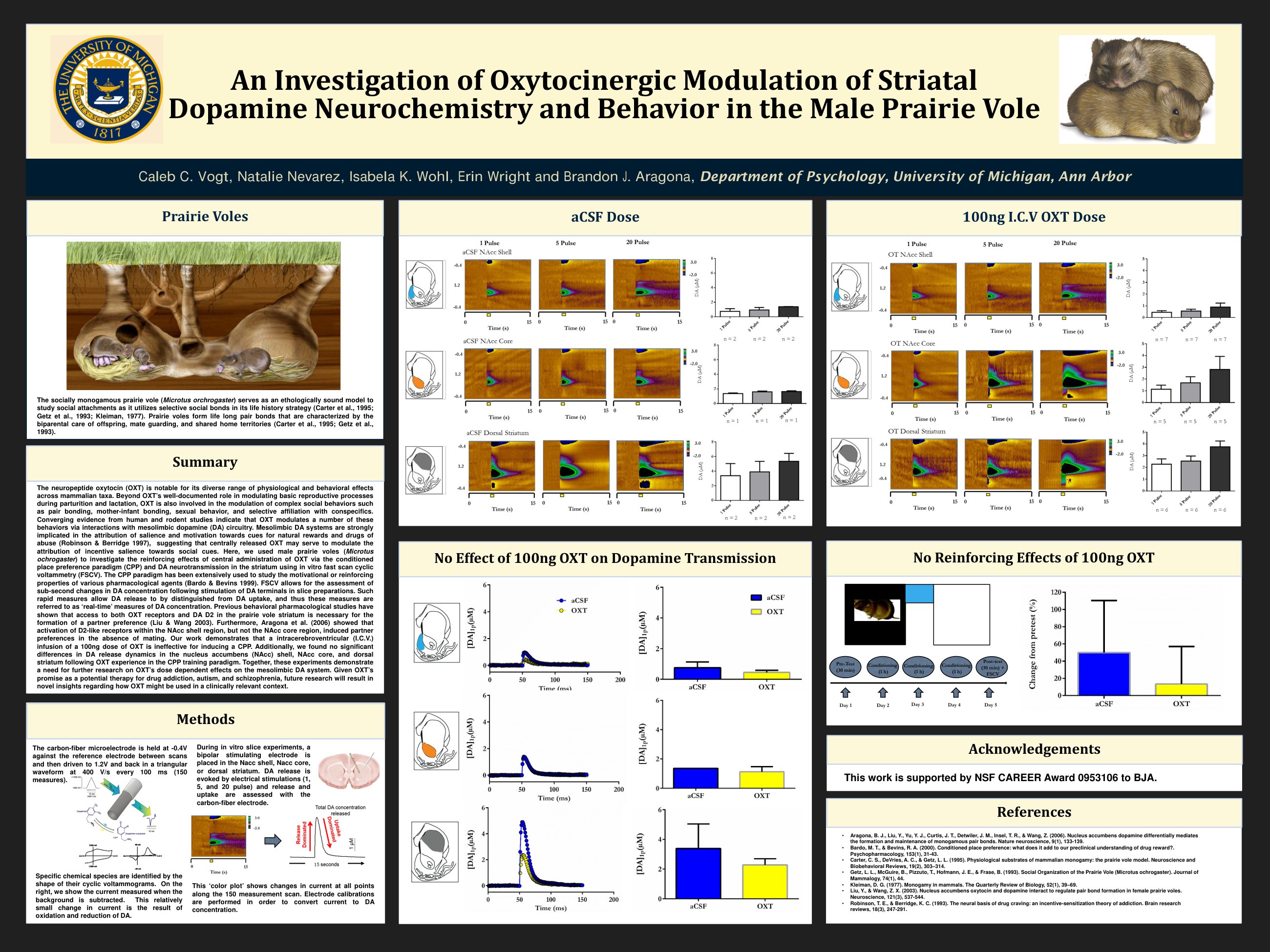
Honors thesis investigating how oxytocin modulates striatal dopamine neurochemistry and social behavior in male prairie voles — the entry point into the attachment questions I work on today.
Most of the voltammetry data here were collected by Isabella “Izzy” Wohl, the lab technician who ran the slice voltammetry rig, with help from Erin Wright. The rig took hours to set up each day, more than an undergraduate’s schedule allowed, so I worked alongside them: I prepared the animals, helped with slicing and at the rig, and analyzed the data. My graduate student mentor, Natalie Nevárez, and Brandon Aragona planned the study with me.
From 2014 to 2016 I worked in Dr. Brandon Aragona’s lab in the Department of Psychology at the University of Michigan, which studied how the brain’s dopamine circuitry supports pair bonding in the socially monogamous prairie vole. My honors thesis asked whether oxytocin, a neuropeptide involved in pair bonding and other social bonds, is reinforcing in itself, and whether experience with it changes dopamine release in the striatum.
Male prairie voles received 100 ng of oxytocin, or the vehicle alone, through a cannula into the brain’s lateral ventricle during a five-day conditioned place preference test: a pretest, three days in which the infusions were paired with one side of a two-chamber cage, and a post-test to see whether the voles had come to prefer the oxytocin-paired side. Brain slices were then prepared, and dopamine release evoked by 1, 5 and 20 electrical pulses was measured with fast-scan cyclic voltammetry in the nucleus accumbens shell, the nucleus accumbens core and the dorsal striatum.
In this sample (6 vehicle and 9 oxytocin voles), 100 ng of oxytocin did not produce a place preference, and evoked dopamine release did not differ between the groups in any of the three regions. The thesis treats these results as preliminary until cannula placements were verified, and points to other doses as the next step. I graduated with Honors in Neuroscience in 2016. The work was supported by NSF CAREER Award 0953106 to B.J.A.