
Head stability in genetically modified mice
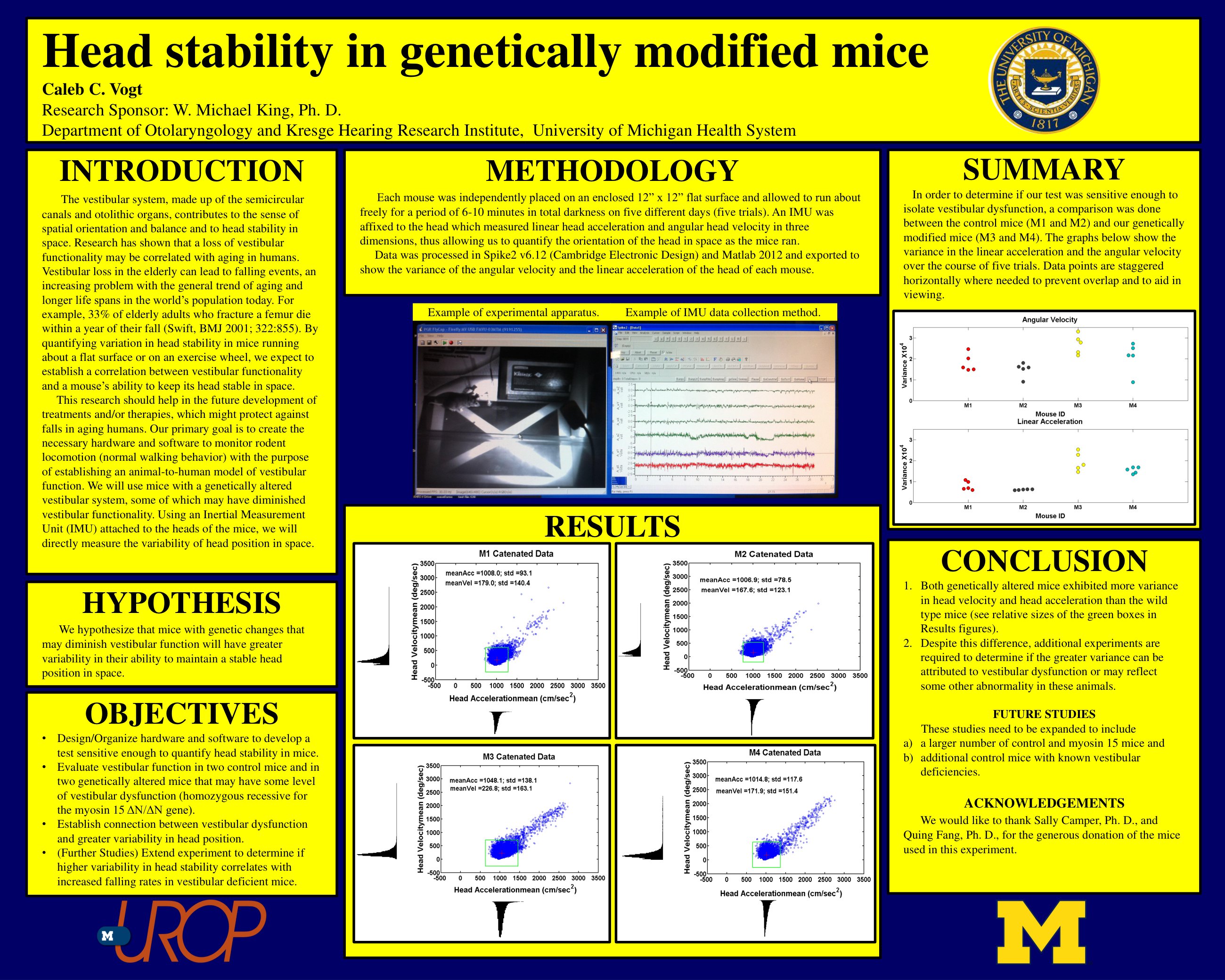
A year in Dr. W. Michael King's vestibular research lab through Michigan's Undergraduate Research Opportunity Program (UROP): a head-mounted motion sensor to measure how steadily mice hold their heads, in mice that might have reduced vestibular function.
In 2012–13 I worked in Dr. W. Michael King’s lab in the Department of Otolaryngology and the Kresge Hearing Research Institute at the University of Michigan, through the Undergraduate Research Opportunity Program (UROP). The lab studies the vestibular system: the semicircular canals and otolith organs of the inner ear, which sense head motion and help keep the head and body steady.
The question was whether head stability could serve as a measure of vestibular function in mice, as a step toward an animal model of the balance loss that leads to falls in older people. I helped put together the hardware and the analysis. A small inertial measurement unit (IMU) on the mouse’s head recorded linear acceleration and angular velocity in three dimensions while the mouse explored a 12 × 12 inch arena in complete darkness, so it could not use vision to steady itself. Each mouse was recorded for 6–10 minutes on five days. I processed the recordings in Spike2 and MATLAB and compared the variance of head motion between two control mice and two mice homozygous for a myosin 15 mutation (Myo15 ΔN/ΔN), which might have reduced vestibular function.
Both Myo15 ΔN/ΔN mice showed more variable head motion than the controls. With two mice per group, the poster concludes that more animals, and controls with known vestibular loss, would be needed before the difference could be attributed to the vestibular system. The mice were a gift from Sally Camper and Qing Fang.