
Tracking hawkmoths at humid flowers
For Ajinkya Dahake's Nature Communications study of floral humidity, I tracked hawkmoths with SLEAP pose estimation and measured their visits to artificial flowers with SimBA's region-of-interest tool.
Ajinkya Dahake’s study asked whether the humidity that rises from a night-blooming flower (Datura wrightii) acts as a signal to its pollinator, the hawkmoth Manduca sexta. Part of the answer came from two-choice flight trials: a moth was offered two artificial flowers that differed only in their humidity, and an infrared camera filmed every visit. My contribution was turning those videos into measurements.
What I did
- Pose tracking with SLEAP. I trained a SLEAP model to find six points on each moth: the eye, thorax, abdomen tip, both wingtips and the tip of the proboscis. The model was trained on 1,669 hand-labelled frames from 137 trial videos and then run on all of the trials.
- SimBA’s region-of-interest tool. In each video I drew regions around the cup of each artificial flower and the space around it. From the tracked points, SimBA measured how long the proboscis tip stayed inside each flower (probing time) and how often the eye, which sits next to the moth’s humidity-sensing antennae, crossed each flower’s rim (floral entries).
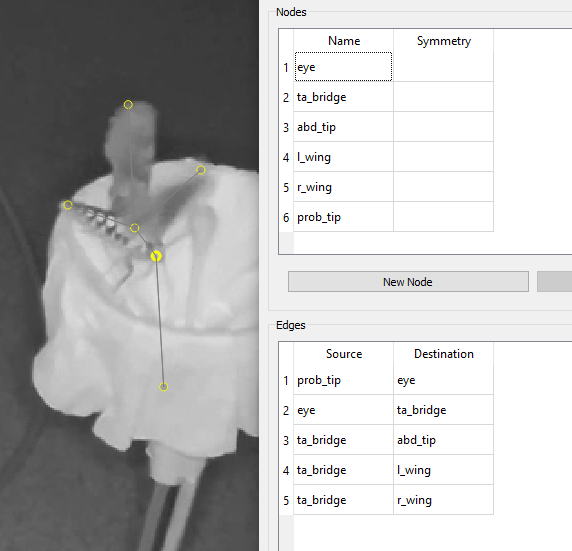
The clip at the top is one tracked trial: the SLEAP skeleton on the moth (the proboscis tip in red, with a short trail), and the SimBA regions around each flower (inner ring: the flower’s cup; outer ring: the space around it).
The paper
Dahake, A., Jain, P., Vogt, C.C., Kandalaft, W., Stroock, A.D. & Raguso, R.A. (2022). A signal-like role for floral humidity in a nocturnal pollination system. Nature Communications. doi:10.1038/s41467-022-35353-8
The paper covers much more than the tracking, including where the flowers’ humidity comes from and how the moths sense it. Read it for the full story.
Thank you to Ajinkya Dahake, a good friend from my graduate cohort, for bringing me onto this project.